
Why Good Leaders Fail in Bad Structures
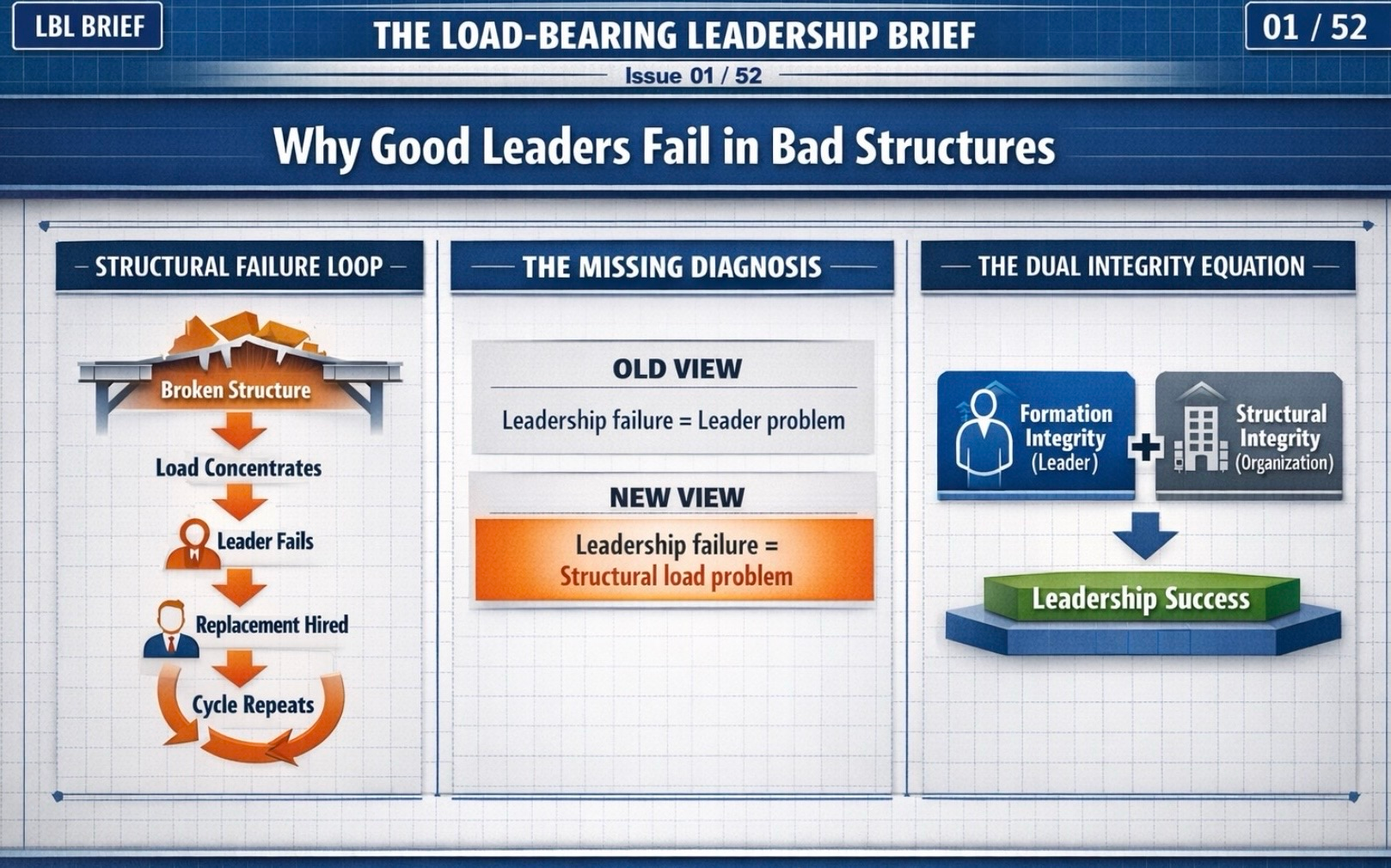
If leadership failure were purely about the individual, replacing the leader should solve the problem. Yet in many organizations, the same failure repeats again and again—new leader, same breakdown.
The real issue is structural.
Organizations concentrate pressure in specific roles, decisions, and accountability systems. When those structures cannot carry the load, leaders fail regardless of talent.
This newsletter explores the architecture of leadership systems—how teams, decisions, and accountability structures either carry weight or collapse under pressure.
Welcome to the Load-Bearing Leadership Brief.
Structure · Load · Leadership · Every week.
Issue 1 · March 29
TL;DR: Your organization didn’t have a leadership problem. It had a structural problem. It hired another leader anyway. It still has the problem. In reality, many organizations fail because their structures cannot carry the load placed on them.
The Load-Bearing Leadership Brief explores how leadership systems must be designed to withstand pressure.
WHERE THIS BEGAN
For forty-nine weeks, I wrote a LinkedIn post called Weekly Wisdom.
Formation. Character. Judgment. Resilience. One post, every week, for nearly a year. I believed in all of it — still do. The inner work of leadership is real and it matters.
But somewhere around week thirty, something began pulling at me.
I kept watching leaders who had done the inner work — the self-awareness, the emotional discipline, the commitment to growth — step into organizations or new roles and come apart anyway. Not because they weren’t ready. But because the structures they stepped into were not built to hold them.
Formation alone wasn’t the whole story. And a LinkedIn post wasn’t the right container for what I kept seeing.
So the posts stopped. And this began.
The Load-Bearing Leadership Brief is the formalization of the question Weekly Wisdom was circling but never fully arrived at. It is a shift — not away from formation, but past the assumption that formation alone is sufficient.
From: who you are as a leader. To: what your leadership actually builds.
Leadership formation matters. Character matters. Judgment matters.
But eventually every leader encounters the same reality: leadership does not live inside the person alone. It lives inside the structure the leader is working within.
This newsletter explores that structure. Not just principles. Architecture. How to design teams, decisions, communication, and accountability so that leadership can actually carry weight without collapsing under the pressure.
This is where the Load-Bearing Leadership System comes fully into view. Let’s begin.
Subject line: The question nobody asked after the last one failed.
Why Good Leaders Fail in Bad Structures
The organizational autopsy almost always names the same cause of a leader’s demise. And it is almost always wrong.
THE HOOK
Consider a pattern you have probably seen before.
A leader joins an organization with a strong record and a clear mandate. She is capable. Experienced. Respected. Eighteen to twenty-four months later she is gone.
Senior leadership meets to discuss what happened. The conversation focuses — as it almost always does — on the leader. Her decisions. Her leadership style. Her ability to work with the culture.
A search firm is hired. Her replacement arrives. And slowly, quietly, the same problems begin to appear again.
The question organizations almost never ask — the question this newsletter exists to ask — is not who failed.
It is: what did the structure fail to carry?
“She was given the title. She was given the mandate. What she was not given was the structure required to use either one.”
In 2024, a regional healthcare network promoted an internal candidate to lead its largest service division — roughly 400 staff, $60 million in annual operations, three years of declining financial performance, rising turnover, and deteriorating physician relationships.
The leader promoted into the role had spent eleven years inside the organization. She knew the culture. She understood the politics. She had credibility with staff and physicians alike. Her supervisor described her as the strongest internal candidate he had seen in a decade.
She was given the title. She was given the mandate. What she was not given was the structure required to use either one.
Decision authority inside the division was split across three administrative systems that had never been reconciled after a merger four years earlier. Her direct reports technically reported to her — but continued receiving direction from two senior administrators whose authority predated her appointment and had never been formally superseded.
Budget approvals required sign-off from a finance committee operating on a 30-day review cycle, making any responsive operational decision structurally impossible. Performance data arrived two months late. Requests for real-time staffing and patient-flow information required IT approval that took eleven weeks.
She commissioned a staff assessment documenting operational breakdowns. The report confirmed exactly what she had already diagnosed. It was quietly filed without response.
She was a capable leader placed inside a structure that had been producing failure long before she arrived. Nothing structural changed when she took the role.
Twenty-two months later she resigned. The exit interview cited burnout and a desire for new challenges. Both explanations were true. Neither actually explained the cause.
THE FRAMEWORK
What happened in that healthcare network is not unusual. It is not even primarily a story about a leader. It is a structural story about what happens when organizations place capable people inside systems designed — unintentionally but reliably — to produce failure.
The Load-Bearing Leadership System begins with a simple observation: organizations are structural systems, and every structural system carries a load.
In buildings, that load is gravity. In organizations, the load looks like decision pressure, communication demands, accountability relationships, interpersonal conflict, trust maintenance, and adaptation to change. Every organization generates this pressure continuously. The structure determines where that pressure goes.
Some structures distribute leadership load effectively. Authority is clear. Information flows quickly. Decisions move at the speed the organization actually needs.
Other structures concentrate that pressure — in single departments, in overloaded roles, sometimes in a single person. When that happens, the structure rarely fails first. The person attached to the structure fails first. And the organization calls it a leadership problem.
Formation Integrity
The maturity, judgment, and resilience of the individual leader. The inner work. Most leadership conversations live here.
Structural Integrity
The capacity of the organizational design to support effective leadership under pressure. Most leadership conversations never arrive here.
Both matter. But when the structure cannot carry the load, the leader eventually breaks under pressure no individual can absorb indefinitely.
Replacing leaders inside a failing structure is not a talent strategy. It is structural denial.
THE IMPLICATION
The most expensive habit in organizational life is diagnosing structural problems as personal ones. Because the interventions that follow address the wrong cause.
Organizations cycle through leaders. Teams lose confidence. The same breakdowns repeat with new names attached. And the structural conditions that produced the failure remain untouched.
The question that interrupts this cycle is simple. But it is not the question organizations are used to asking.
Not: What was wrong with the leader?
But: What was the structure doing while the leader was failing?
That question changes everything. Because once it is asked clearly, the conversation moves from personalities to design. And from blame to architecture.
This newsletter exists to build that vocabulary. Each week we will examine one structural leadership pattern — a recurring design flaw, pressure point, or failure mode that appears across organizations but is rarely named clearly. Not motivational content. Not quick leadership tips. Just the structural realities most leadership conversations never address.
Because nothing structurally useful can happen until the right question is asked.
The right question is not who failed. It is what the structure failed to carry.
Everything else follows from that.
ONE QUESTION TO SIT WITH
Think about the last leadership failure you witnessed — or lived through.
The official explanation probably focused on the person.
Now ask a different question.
What did the structure fail to carry?
THE BOOK
Load-Bearing Leadership: The System
This newsletter draws from a System developed through years of consulting, leadership research, and study of organizational systems.
The book lays out the full architecture: the Dual Integrity Model, the Four Leadership Lanes, the 22 Structural Gates, and structural retrofit methods for redesigning overloaded leadership systems.
If this issue named something you have been watching happen inside your organization — or something you have lived through yourself — the book explains how to diagnose it and what to build instead.

Get the latest stories, leadership insights, and special offers delivered straight to your inbox.
Next Issue:
Issue 02 —Your Organization is Carrying Something It Was Never Built to Hold.
Published weekly by J.A. Tomlinson
I’m here to help. Let’s talk.
All rights reserved. Load-Bearing Leadership System™ is a pending trademark.