TL;DR
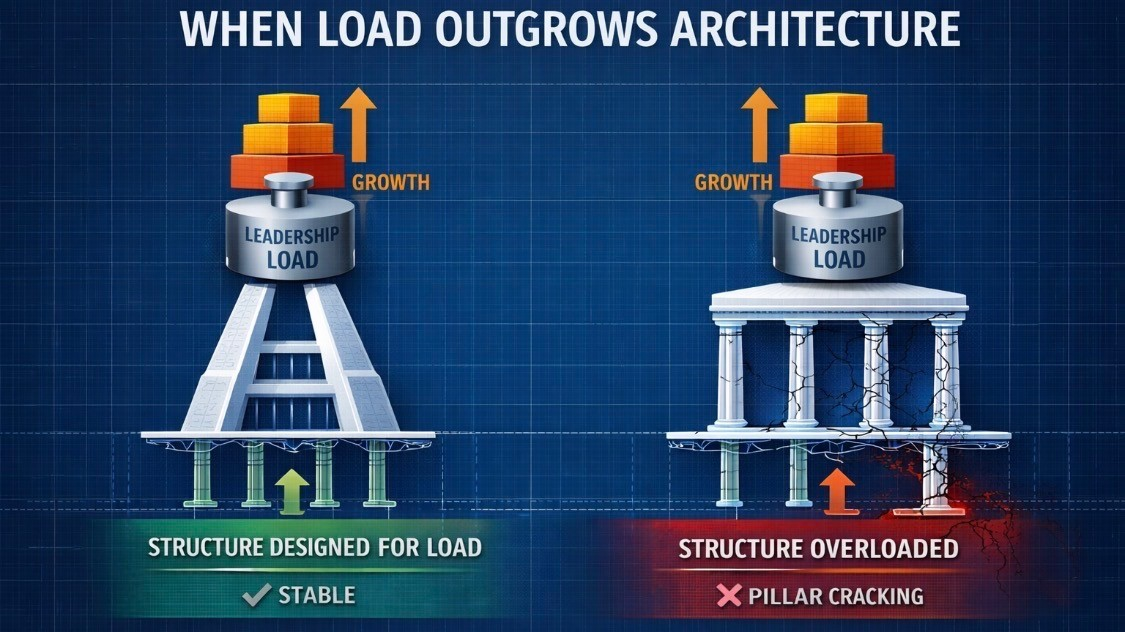
Your organization may not be struggling because people are underperforming.
It may be struggling because the structure is carrying more weight than it was ever designed to hold.
When the load grows faster than the architecture, the pressure does not disappear.
It accumulates—until it finally breaks the people attached to it.
In this issue
• Why growth often outpaces organizational architecture
• How leadership load accumulates inside structures
• The four structural lanes through which organizational pressure moves
THE HOOK
There is a moment in the life of almost every growing organization when the load outpaces the architecture.
It does not announce itself. It accumulates.
First, it appears as friction—decisions that take longer than they should, communication that reaches the wrong people at the wrong time, and accountability conversations that happen too late or not at all.
Then it appears as personnel problems: the manager who was effective at twenty people but struggles at fifty, the founder who sits in every meeting because the structural design has not figured out how to operate without her, the executive team that meets weekly and leaves every meeting carrying exactly the same unresolved weight they walked in with.
Then it appears in the turnover numbers.
Then the performance numbers.
Then—almost inevitably—as a conversation about leadership.
But the leadership conversation is usually arriving late.
The load was always the leading indicator.
The leadership diagnosis was the lagging one.
Most organizations reverse that sequence and pay for it repeatedly.s.
THE STORY
In 2021, a mid-market professional services firm with 340 employees and four regional offices decided to double in size.
The growth plan was credible. The market was expanding, the firm’s reputation was strong, and the capital was available. What the plan did not include was a structural redesign to support the organization it intended to become.
The firm had been built around a founding partnership model. Seven senior partners carried the full weight of client relationships, business development, quality oversight, and internal decision-making.
At eighty people the model worked beautifully.
At one hundred eighty people—three years into steady growth—it was beginning to strain. The partners were working longer hours than at any point in the firm’s history. Decisions that should have been made at the manager level were consistently escalating upward because the authority architecture had never been redistributed. Communication traveled through the partners’ personal networks because no formal communication structure existed that did not route through them.
The growth plan added another 160 employees over eighteen months.
By the end of the second year of expansion, three of the seven founding partners had resigned. A fourth was on medical leave attributed to exhaustion. The firm’s largest regional office had seen forty percent turnover in its management layer.
Two major client relationships—worth nearly $5 million annually—terminated their contracts, citing inconsistent service quality and unclear accountability.
The board commissioned a leadership assessment.
The resulting report recommended executive coaching, leadership team restructuring, and a culture initiative focused on accountability and communication.
The report analyzed the people in the building with considerable sophistication.
It did not once ask what the structural design was doing to those people.
The firm had not developed a leadership problem.
It had scaled the weight before it built the structure capable of bearing it—and then routed the entire weight of that decision through seven human beings who were not structural failures.
They were structural victims.
The architecture had been overloaded.
And when architecture fails, the failure routes through the people attached to it.
THE FRAMEWORK
The story above is not unusual.
It is structural.
Last week this newsletter introduced the foundational premise of Load-Bearing Leadership: organizations are structural systems, and leadership failure is often a structural problem misdiagnosed as a personal one.
This week the framework becomes more precise.
Because the concept that makes this idea useful is not simply structure.
It is leadership load.
Leadership load is the aggregate pressure that an organizational system generates and routes through its leadership architecture.
This is not a metaphor for stress. It is not another way of saying responsibility.
It is a structural concept.
Leadership load is the sum of all the forces operating simultaneously inside an organization:
Leadership load is the sum of all the forces operating simultaneously inside an organization:
- decision pressure
- accountability demands
- communication burden
- conflict management
- trust maintenance
- adaptive change
Every organization generates these pressures continuously.
The structural question is not whether the pressure exists.
The structural question is where the system sends it.
Load grows with complexity.
More people create more decision rights to clarify, more communication pathways to maintain, and more accountability relationships to manage.
More locations increase coordination overhead.
More services increase standards complexity.
Faster growth increases the rate at which pressure accumulates.
Unless the structural architecture expands with that growth, the pressure concentrates.
And concentrated load behaves predictably.
At first nothing appears wrong. The strongest people simply carry more.
But load does not disappear. It compounds.
Eventually the symptoms appear—burnout, turnover, decision delays, communication failures.
Organizations interpret these as culture problems or leadership weaknesses.
These are really structural signals.
Inside the Load-Bearing Leadership framework, organizational load travels through four structural channels:
Truth Lane – the movement of accurate information and organizational reality.
Power Lane – the distribution of authority, decision rights, and accountability.
People Lane – the management of trust, relationships, and conflict.
Standards Lane – the maintenance of expectations, execution quality, and performance consistency.
Each lane carries part of the system’s pressure.
If one lane becomes overloaded, the pressure does not vanish.
It reroutes.
And the adjacent lanes begin carrying weight they were never designed to hold.
This is how structural failure propagates through organizations.
STRUCTURAL VOCABULARY
Leadership Load
The aggregate structural pressure an organization generates and routes through its leadership architecture.
Structures determine whether that pressure is distributed across the system—or concentrated in a few overloaded roles.
THE IMPLICATION
If leadership load is structural rather than personal, then the conversation about “overloaded leaders” is usually the wrong conversation.
The real question is what structural design is producing that overload.
Every growth initiative increases load.
Every new service line, acquisition, market expansion, or hiring wave adds pressure to the leadership architecture already supporting the organization.
The structural question almost never asked in growth planning conversations is this:
Does the current architecture have the capacity to carry what this initiative will add?
And if it does not, what structural investment is required alongside the growth investment?
Organizations that carry load well are not necessarily the ones with the most talented leaders.
They are the ones whose structural design distributes pressure across enough load-bearing points that no single role is forced to absorb more than the system can support.
That outcome is not a function of talent.
It is a consequence of architecture.
Leadership development strengthens people.
Structural design determines whether those people can succeed.
ONE QUESTION TO SIT WITH
Map the decision-making load in your organization right now.
Where does the weight actually land—not where the org chart says it should go, but where it actually goes when something consequential needs to happen?
Was that distribution designed?
Or did it accumulate?
NEXT ISSUE
When the Building Was Always Going to Fall
Why some leadership failures are predictable from the moment a role is created—because the structure was never designed to succeed.
FREE RESOURCE
The Framework Overview
The Dual Integrity Model, the Four Leadership Lanes, and the structural load concept introduced in this issue are developed in full in the Load-Bearing Leadership System framework.
Download the Framework Overview for a map of the system:
• The Four Leadership Lanes
• Structural load patterns
• Early indicators of architectural strain
• Diagnostic logic for identifying overloaded systems
→ Download the Framework Overview at
THE LOAD-BEARING LEADERSHIP BRIEF
Published weekly by J.A. Tomlinson