The Difference Between Closure and Confidence
Why leaders who move fast are often building on sand — and why clarity and closure are not the same thing.
Read the full postFor leaders, coaches, teams, and organizations carrying more weight than their structure can support.
Load-Bearing Leadership™ is the home of the Dual Integrity Model™: inner formation plus outer structure. Start with the free Leader Guide, take DIAL Lite, explore the framework, read the book, or find the right path for coaching and enterprise use.
Read the guide, take the free assessment, then decide whether the book is your next step.
Review certification, practice tools, and how DIAL can fit a client-facing model.
This homepage is the hub. These are the three clearest entry points, depending on who you are and what you need.
If you want a credible place to start without jumping straight into the whole ecosystem, this is the cleanest path. Understand the model, then get your first reading.
Explore certification, toolkits, workshop materials, and the long-form assessment path for more serious coaching and client work.
For leadership teams, consulting buyers, and transformation groups evaluating whether the system can reduce friction, clarify decisions, and strengthen accountability.
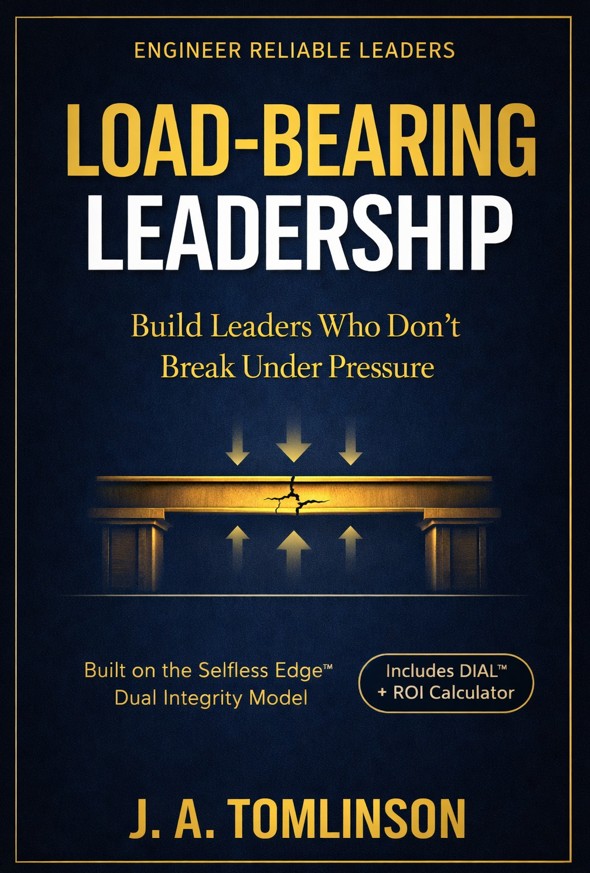
Most leadership frameworks tell people to become more resilient, more inspiring, or more disciplined. Load-Bearing Leadership™ asks a structural question first: what is carrying the weight?
The answer is the Dual Integrity Model™. Leaders need both inner formation and outer structure. Without both, pressure concentrates in predictable places: truth arrives late, decisions bottleneck, standards drift, and the strongest person in the room becomes the patch.
Five pillars that strengthen how a leader thinks, steadies, acts, and carries responsibility under pressure.
See the 5 PillarsFour lanes and 22 Gates that show where organizations hide friction, distort truth, or overload leaders.
See the 22 GatesThe DIAL™ assessment family is still in final edit. That means the framework, book, and free assessment can be used now, but any large outcome figures should be read as illustrative projections, not completed pilot data.
This is a trust advantage, not a weakness. The system is designed to be transparent about where it is in its lifecycle: published framework and book, live free entry tool, and future research and enterprise validation still in progress.
See the transparency language on the leader pageUse the model now to understand the system. Expect future pilot and validation work to replace modeled projections with case data over time.
This section is for readers who want the argument behind the framework: why leaders break, why systems matter, and why formation without structure is not enough.
“Formation without structure produces burnout. Structure without formation produces coercion. Neither produces sustainable leadership.”
— Load-Bearing Leadership
The central case of Load-Bearing Leadership™ is that many organizations overload their strongest people, then mistake that overload for a character problem. Start here if you want the core thesis.
See the leader pageHeroic Compensation — strong leaders absorb what structure should carry.
Hollow Structure — systems exist on paper, but leaders lack the formation to run them honestly.
Why ambiguity costs more than structure and why safety requires design, not slogans.
ReadThe book is still the deepest single place to understand the intellectual architecture of the system.
For readers who want a more guided learning path, the module concept organizes the framework into teachable sequences.
Five learning arcs following the same progression as the Formation side of the framework.
Preview the pillarsA practical way to help students and leaders learn how the lanes and Gates work in real systems.
Preview the GatesFor faculty and program leaders who want to build the model into courses or cohorts.
Request educator accessThe book remains the simplest starting point. Licensing and educational paths can build from there.
This area houses the conceptual research story behind the framework: literature, case logic, research status, and future validation work.
A conceptual modeling approach to leadership friction, delay, rework, and turnover costs.
See the methodologyCurrent status of the assessment family and how the research lifecycle is being framed.
Request the briefA path for certified practitioners and partners to help build the evidence base over time.
Contact usThe research story is still early, but transparent. That makes it easier for serious partners to understand where the system is now.
For coaches, consultants, and facilitators who need more than soft insight language. The LBL ecosystem gives you structural vocabulary, assessment pathways, and facilitation tools.
The coach path is where the framework begins to shift from content into professional infrastructure.
Understand the assessment family and how the free, short-form, and long-form versions fit together.
See DIAL™Client-ready materials, workshop structures, and practical aids for using the system with others.
View toolkitThe clearest next step for coaches who want to build an offering around the model.
See certificationUse the coach page when you want the product ladder, toolkit, certification path, and professional positioning in one place.
This path is for leadership teams, transformation leaders, and consulting buyers who want to evaluate whether the framework can reduce friction, improve decision flow, and strengthen accountability.
A lighter support option for leadership teams that want guided implementation without a full consulting engagement.
Ask about Foundation BuildA larger, multi-Gate engagement for organizations dealing with concentrated structural load.
Schedule consultationUse the brittleness-tax logic to estimate what friction, delay, and turnover may be costing your organization.
Open calculatorStart with a call, not a giant commitment. The first conversation is about whether the problem is structural enough to justify this kind of work.
This is where the ecosystem broadens: practitioners, leaders, students, partners, and future story-sharing or forum-based spaces.
The community side matters because structural work is easier to sustain when people are not doing it alone.
The working community for certified coaches and consultants using the framework in real engagements.
Join as a practitionerA future-facing path for learners working through the framework in courses and cohort settings.
Ask about accessFor people interested in expanding the framework into wider mission, education, or underserved contexts.
Explore partnershipThe homepage keeps this visible because the long-term vision is bigger than a book page or a single assessment.
The blog is where shorter-form writing can keep the ecosystem alive between books, tools, and consulting conversations.
Why leaders who move fast are often building on sand — and why clarity and closure are not the same thing.
Read the full postA recurring pattern in fast-growth organizations.
ReadA practical way to shift client conversations.
ReadWhy good intentions do not remove structural load.
ReadFor some readers, the blog will be the bridge from curiosity to the book, the guide, or the assessment.
This homepage is the hub, but it should still move people somewhere specific. Start with the Guide, the free assessment, the framework, or the page built for your audience.